What Is a Seed Phrase? How Wallet Recovery Works—and Why You Must Keep It Secret

On this page
A seed phrase is a human-readable backup that can be used to reconstruct the cryptographic keys behind many self-custody wallets. It is not simply a password for opening an app. In a compatible wallet, the same recovery information can recreate the key structure that gives you control over your crypto assets.
The simple model: your wallet app is replaceable. Your seed phrase may not be. If your phone disappears but you still have the correct recovery information, you can often rebuild the wallet. If someone else obtains that information, they may be able to rebuild it too.
- What is a seed phrase?
- A seed phrase is not your wallet
- How does a seed phrase become wallet keys?
- 1. The wallet starts with randomness
- 2. The mnemonic is converted into a seed
- 3. The seed creates a deterministic key tree
- 4. Derivation paths tell the wallet where to look
- What happens when you recover a wallet?
- Seed phrase vs private key: what is the difference?
- Why isn’t a seed phrase just a password?
- What happens if someone steals your seed phrase?
- What happens if you lose your seed phrase?
- What about an optional BIP39 passphrase?
- Are all seed phrases BIP39?
- Why can’t you invent your own seed phrase?
- How should a seed phrase be protected?
- The difficult part: backup security is a trade-off
- Common misconceptions about seed phrases
- “My coins are stored inside the seed phrase.”
- “If I lose my phone, I lose my crypto.”
- “My wallet password protects me if someone has my seed phrase.”
- “The wallet company can reset my seed phrase.”
- “All 12-word phrases work in every wallet.”
- Why seed phrases matter to self-custody
- Key takeaways
What is a seed phrase?
A seed phrase, often called a recovery phrase or mnemonic phrase, is a sequence of words used by many cryptocurrency wallets as a human-readable representation of the information needed to derive wallet keys.
One widely used system is BIP39, a specification introduced for deterministic wallets. BIP39 describes how computer-generated randomness can be encoded as a mnemonic sentence and then converted into a binary seed. That seed can subsequently be used by a deterministic wallet system such as BIP32 to generate cryptographic keys.
This distinction matters because the words are not merely a memorable password chosen by the user. In BIP39, they encode computer-generated entropy plus a checksum. The resulting mnemonic is then processed to produce a seed.
BIP39 supports specific entropy sizes from 128 to 256 bits. Because of the way entropy and checksum bits are divided into groups that map to a 2,048-word list, valid BIP39 mnemonic lengths are 12, 15, 18, 21 or 24 words.
Twelve and 24 words are common in wallet interfaces, but not every recovery system is BIP39 and not every wallet uses the same backup format.
A seed phrase is not your wallet
The word “wallet” can create a misleading mental picture. A crypto wallet does not normally contain coins in the way a physical wallet contains cash.
The assets themselves are represented by records on a blockchain. What the wallet manages are cryptographic keys and related information that allow it to identify accounts and authorize transactions.
That leads to a more useful model:
Blockchain: records the assets and transactions.
Private keys: provide the cryptographic ability to authorize actions for corresponding accounts.
Wallet software: manages keys, addresses and transactions.
Seed phrase: can serve as backup material from which a deterministic wallet’s keys can be reconstructed.
Deleting a wallet application therefore does not delete coins from a blockchain. Likewise, destroying a phone does not erase blockchain balances. The critical question is whether the keys required to control those assets can still be reconstructed.
How does a seed phrase become wallet keys?
For a typical BIP39/BIP32-style wallet, recovery can be understood as a chain of deterministic transformations.
1. The wallet starts with randomness
A BIP39 implementation begins with computer-generated entropy. It adds checksum information and divides the resulting bits into groups. Each group corresponds to a word from a standardized list of 2,048 words.
The words therefore provide a more practical way for a person to record data that would otherwise be represented as a long binary or hexadecimal value.
2. The mnemonic is converted into a seed
Under BIP39, the mnemonic sentence is processed using the PBKDF2 key-stretching function with HMAC-SHA512. An optional BIP39 passphrase can also participate in this process.
The result is a 512-bit seed.
This is one reason everyday terminology can be confusing. People frequently call the list of words itself a “seed phrase,” although technically the BIP39 mnemonic is an input used to derive the binary seed.
3. The seed creates a deterministic key tree
BIP32 defines hierarchical deterministic, or HD, wallets. Instead of generating every private key independently and requiring separate backups, an HD wallet can derive a tree of keys from a single root.
Conceptually, the process looks like this:
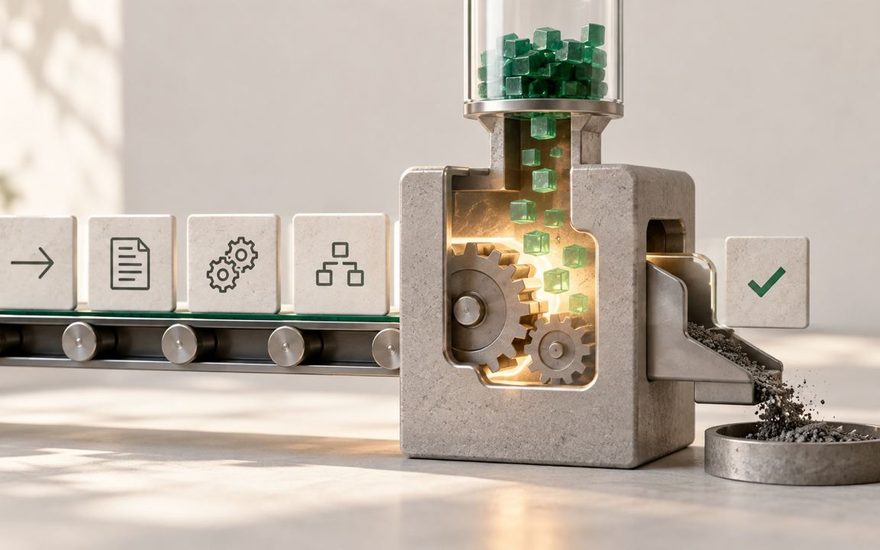
Mnemonic words → binary seed → master key material → child private keys → public keys → wallet accounts and addresses
The important property is determinism: given the same required inputs and compatible derivation rules, the wallet can reproduce the same key tree.
That is what makes recovery possible.
4. Derivation paths tell the wallet where to look
Generating a root is only part of the problem. Wallet software also needs conventions for organizing derived keys.
BIP44, for example, defines a hierarchy with levels for purpose, coin type, account, change and address index. Its general structure is:
m / purpose' / coin_type' / account' / change / address_index
These conventions help compatible software find accounts and addresses in predictable places. Other wallet standards and ecosystems may use different derivation schemes.
This is why having the correct words does not guarantee that every wallet application will immediately display every account you expect. Recovery also depends on compatibility with the relevant standards, derivation paths, asset types and other wallet-specific parameters.
What happens when you recover a wallet?
Imagine that a phone containing a self-custody wallet is lost.
The crypto has not moved simply because the phone disappeared. The blockchain continues to contain the same transaction history and account state.
You install compatible wallet software on another device and enter the recovery phrase. The software processes the mnemonic according to its recovery scheme, derives the seed and reconstructs the relevant key hierarchy. It can then derive addresses and inspect the blockchain for assets associated with them.
The new device has not downloaded coins from the old phone.
It has reconstructed the cryptographic credentials needed to control the same blockchain accounts.
Recovery is key reconstruction, not asset transfer. The blockchain does not need to move your assets from the lost device to the new one.
Seed phrase vs private key: what is the difference?
| Seed phrase | Private key |
|---|---|
| Usually serves as recovery material for a deterministic wallet | Controls a specific cryptographic keypair |
| Can lead to many derived private keys | Corresponds to a particular public key |
| Often represented as human-readable words | Normally represented internally as cryptographic data |
| May restore an entire hierarchy of accounts | Usually provides authority associated with that individual key |
The relationship explains why a seed phrase is such a sensitive secret. Compromising one private key can expose assets controlled by that key. Compromising the root recovery material of an HD wallet can expose many keys derived from it.
In practical security terms, a recovery phrase should therefore be treated as highly sensitive signing authority, not as ordinary login information.
Why isn’t a seed phrase just a password?
A conventional password usually authenticates you to a service. A company maintains an account, checks your credentials and may provide a password-reset mechanism if you lose them.
A self-custody wallet works differently.
The blockchain does not know your name, email address or customer-support identity. It recognizes valid cryptographic authorization.
If your recovery material is lost and no other usable backup or key remains, there may be no central operator capable of resetting it. Conversely, if another person obtains sufficient recovery information, the blockchain does not know that this person is a thief rather than the original owner.
Valid signatures are what matter to the protocol.
This changes the security model from account recovery by an institution to recovery controlled by possession of cryptographic secrets.
What happens if someone steals your seed phrase?
If an attacker obtains a complete seed phrase for a conventional single-backup HD wallet, and no additional secret is required, the attacker may not need your phone, wallet password, fingerprint or physical hardware wallet.
They can potentially import the recovery material into compatible software, reconstruct the relevant private keys and create valid transactions.
A local PIN or biometric lock still has value: it can protect the wallet application and device against unauthorized local access. But it should not be confused with protection against a compromised recovery phrase.
Critical distinction: a device password protects access to a device or application. A seed phrase can provide a path to reconstructing the keys somewhere else.
This is also why legitimate recovery phrases should not be entered into websites, forms, unsolicited support chats or applications whose authenticity you cannot establish. A request for your complete recovery phrase should be treated as a high-risk event.
What happens if you lose your seed phrase?
Losing the written backup does not necessarily cause an immediate loss of funds if a working wallet still holds the required keys. But it removes an important recovery path.
If that device later fails, is lost, is wiped, or becomes inaccessible, recovery may become impossible unless another valid backup exists.
The situation is more serious when both the usable wallet and all recovery material are gone. In a genuinely self-custodial setup, there may be no administrator with a master key and no “forgot seed phrase” button.
This is one of self-custody’s fundamental trade-offs: removing reliance on a custodian also removes many of the custodian’s account-recovery mechanisms.
What about an optional BIP39 passphrase?
BIP39 defines an optional passphrase in addition to the mnemonic sentence. The passphrase participates in the process that derives the seed.
This is sometimes described by wallet interfaces as an additional word or an extra passphrase, but it is not simply another mnemonic word.
An important technical property is that every passphrase produces a valid seed. The system cannot inherently tell you that you typed the “wrong” passphrase; a different passphrase simply leads to different derived wallet data.
That can provide an additional security layer in compatible setups, but it also creates another failure mode. If the mnemonic survives but the required passphrase is permanently forgotten, the intended wallet may not be recoverable from the mnemonic alone.
Whether to use such a feature depends on the wallet and the user’s backup design. It should not be enabled without understanding exactly how recovery works.
Are all seed phrases BIP39?
No.
BIP39 is widely recognized, but it is not a universal definition of every crypto-wallet recovery system. Wallets can use different standards and backup designs.
For example, SLIP39 specifies a different approach based on Shamir’s Secret Sharing. Instead of relying on one mnemonic backup, a secret can be split into multiple mnemonic shares, with a defined threshold required to reconstruct it.
SLIP39 describes a standard for backing up hierarchical deterministic wallets and is largely incompatible with BIP39.
Other modern wallets may use multisignature configurations, social recovery, hardware-specific backup mechanisms, cloud-assisted recovery or newer account architectures.
So “write down these words” is not a complete description of wallet recovery in general. The exact recovery model depends on the wallet.
Why can’t you invent your own seed phrase?
A recovery phrase may look like a collection of ordinary English words, which can make it tempting to create one manually.
That defeats the purpose of the system.
BIP39 is designed to encode computer-generated randomness. Its specification explicitly states that the mechanism is not intended to turn user-created sentences into wallet seeds.
Humans are poor sources of cryptographic randomness. We choose recognizable phrases, patterns, quotations and combinations that can dramatically reduce the search space available to an attacker.
A recovery phrase should be generated by a wallet or device using an appropriate cryptographic process, not composed as a memorable sentence by the user.
How should a seed phrase be protected?
The right backup design depends on the amount of value involved, the wallet architecture and the threats you are trying to defend against. But several principles follow directly from what a seed phrase does.
- Keep it secret. Anyone with sufficient recovery material may be able to reconstruct your wallet.
- Keep it recoverable. A backup that nobody can steal but that you cannot access after a disaster has also failed.
- Do not invent the words yourself. Use recovery material generated by the wallet’s intended cryptographic process.
- Verify the backup carefully. Word order and spelling matter.
- Understand the recovery scheme. Know whether your wallet uses BIP39, an additional passphrase, multiple shares or another method.
- Be cautious with digital copies. Screenshots, notes, cloud documents and messages can create additional places from which the secret can leak.
- Never disclose it to “support.” Recovery material should not be needed by someone merely helping you troubleshoot a wallet.
- Test your recovery process safely. A backup is useful only if it contains everything required to reconstruct the intended wallet.
The difficult part: backup security is a trade-off
Seed phrase security has two opposite failure modes.
If you make many easily accessible copies, you reduce the chance of accidental loss but increase the number of places from which the secret can be stolen.
If you keep a single extremely well-hidden copy, you reduce exposure but increase the risk that fire, flooding, physical damage, loss or your own inability to locate it destroys the only backup.
More sophisticated systems attempt to change this trade-off. Threshold schemes can distribute recovery information across several locations. Multisignature wallets can require multiple independent keys. Additional passphrases can separate one piece of recovery information from another.
But additional complexity introduces its own risks: forgotten secrets, incompatible software, incorrect configuration and recovery procedures that nobody has successfully tested.
Security is not simply “hide the phrase better.” A sound recovery design has to defend against both unauthorized access and permanent loss.
Common misconceptions about seed phrases
“My coins are stored inside the seed phrase.”
No. The blockchain records the relevant assets and transactions. The recovery phrase provides a route to reconstructing cryptographic keys that can control them.
“If I lose my phone, I lose my crypto.”
Not necessarily. If you retain the required recovery information and compatible software exists, the wallet can often be reconstructed on another device.
“My wallet password protects me if someone has my seed phrase.”
A local wallet password generally protects the local application or stored wallet data. It does not necessarily prevent someone with the recovery material from reconstructing the keys elsewhere.
“The wallet company can reset my seed phrase.”
That depends on the wallet architecture, but in a conventional self-custody setup there is no central password-reset mechanism for cryptographic keys. If only you possess the recovery secret, the provider may have nothing it can reset.
“All 12-word phrases work in every wallet.”
No. Word count alone does not establish compatibility. Recovery standards, derivation paths, passphrases, networks and wallet-specific implementations can differ.
Why seed phrases matter to self-custody
A seed phrase solves an important usability problem created by cryptography.
A modern deterministic wallet may need to manage many keys and addresses. Backing up every private key independently would be cumbersome and error-prone. Hierarchical deterministic wallets allow many keys to be derived from common root material, while mnemonic systems make critical recovery data easier for humans to record.
That convenience concentrates responsibility.
The same backup that makes it possible to recover an entire wallet after losing a device can also allow an attacker to reconstruct that wallet after stealing the backup.
There is no contradiction here. Recovery and theft are cryptographically similar operations: in both cases, someone possessing the necessary secret reconstructs keys on another device. The protocol cannot infer why they are doing it.
Key takeaways
- ✓ A seed phrase is recovery material used by many self-custody wallets to reconstruct deterministic wallet keys.
- ✓ In BIP39, mnemonic words encode computer-generated entropy and a checksum; the mnemonic is then transformed into a binary seed.
- ✓ BIP32-style HD wallets can derive a hierarchy of keys from common root material.
- ✓ Wallet recovery reconstructs cryptographic keys; it does not transfer coins out of the old device.
- ✓ A seed phrase is not the same thing as a normal account password.
- ✓ Someone who obtains sufficient recovery information may be able to control the wallet without possessing the original device.
- ✓ Losing both the usable keys and the only recovery material can make self-custodied assets permanently inaccessible.
- ✓ BIP39 is common but not universal. Recovery systems can use different standards, derivation schemes, passphrases or threshold designs.
- ✓ The core backup problem is balancing secrecy against recoverability.

Discussion