What Is a Blockchain Oracle? How Smart Contracts Get External Data

On this page
A lending contract can calculate whether a borrower has enough collateral. But where does it get the price of that collateral? The blockchain records token balances; it does not automatically know what those tokens are worth in dollars.
A blockchain oracle is a system that makes information available to smart contracts. It connects a source of data with the rules that an application executes. Price feeds are a familiar example, but applications can also need weather observations, event outcomes, or other information originating outside their own blockchain.
The useful mental model is a data pipeline: observe, report, verify, then use. Each stage answers a different question. A report can be authentic and correctly processed while still containing an outdated or misleading observation.
- Why a smart contract cannot simply check a website
- The oracle is a pipeline, not a source of perfect truth
- How a price report reaches a contract
- 1. Operators obtain observations
- 2. Observations become an authenticated report
- 3. The accepted answer becomes available onchain
- 4. The application decides whether and how to use it
- Push and pull describe delivery, not reliability
- Example: the same collateral, a different borrowing position
- “Latest” does not necessarily mean current
- Onchain prices can need oracles too
- Where oracle risk actually comes from
- Many reporters can share one weak source
- The application can misuse good data
- Administrative control can change the dependency
- How to read an application’s oracle design
- What to remember
Why a smart contract cannot simply check a website
On Ethereum, nodes executing the same transaction against the same starting state must obtain the same result. This property is called deterministic execution.
If each node independently fetched a price from a website during execution, they could receive different answers. One might query before a price change, another after it, and a third might receive an error. The network would no longer have a reproducible calculation.
Instead, an oracle delivers information through a process the blockchain can verify. Once accepted into blockchain state, that information becomes a shared input. Nodes can agree on what the contract received and how it used it.
Our explanation of how smart contracts execute predefined rules covers the execution layer. Oracles address a separate question: where the inputs come from.
The oracle is a pipeline, not a source of perfect truth
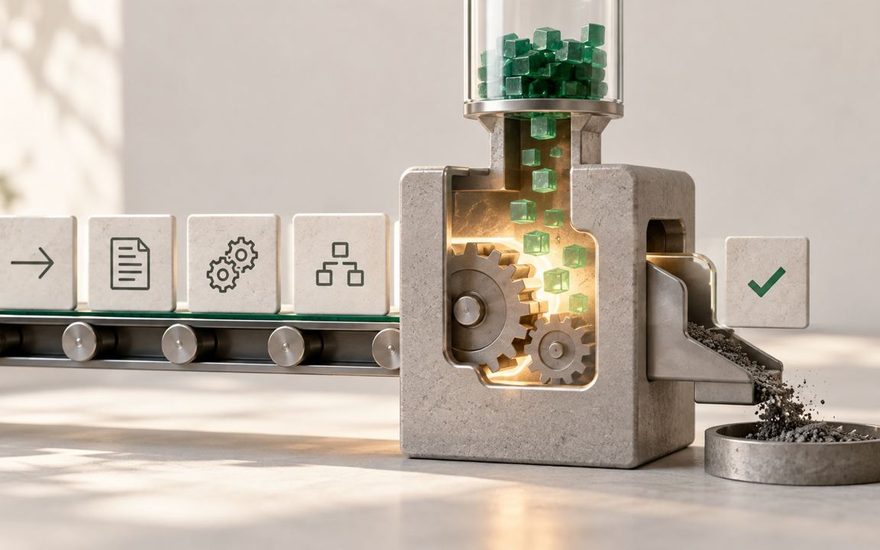
Think of an oracle as a reporting desk supplying information to an automated decision system. Reporters collect observations, a process reconciles them, and a published report becomes available to applications.
The analogy helps separate observation from action. It breaks down because real oracle systems use software, cryptographic authentication, transactions, and explicit acceptance rules rather than an editor’s judgment.
A useful way to inspect the pipeline is to identify four responsibilities:
- Sources: produce the underlying observations, such as prices from trading venues.
- Reporters: collect or relay those observations.
- Verification and aggregation: determine which reports are acceptable and how they become a usable answer.
- Consumer: the application contract that interprets the answer and makes a decision.
These responsibilities may be distributed among several organizations and contracts. They may also be concentrated in one operator. The word “oracle” alone does not tell you which arrangement applies.
How a price report reaches a contract
Consider a representative architecture: a network of oracle operators supplying a shared price feed. The details vary, but the sequence makes the mechanism concrete.
1. Operators obtain observations
Oracle operators obtain data according to the feed’s methodology. The definition matters: a price for an asset in dollars is different from its price in another token, and a market price is different from a contractual redemption rate.
Several operators can participate, but the number of operators is only one part of the design. Their underlying sources also matter.
2. Observations become an authenticated report
In Chainlink’s Offchain Reporting architecture, nodes exchange observations outside the blockchain and assemble a report. A required quorum signs it, and a transmitting node submits it onchain.
The receiving contract verifies the required signatures and exposes an aggregated answer. This reduces the need for every reporter to submit a separate blockchain transaction.
The signatures establish that the configured participants approved the report. They do not independently establish that every underlying market observation was economically representative.
3. The accepted answer becomes available onchain
An aggregator contract stores accepted feed data in blockchain state. Applications can read it directly or through a proxy that points to the relevant aggregator. Chainlink’s data model documentation describes these components.
The blockchain verifies the update transaction and the contract’s acceptance rules. It does not visit every exchange to repeat the original observation.
4. The application decides whether and how to use it
A consumer contract reads the answer and applies its own rules. A lending application might use it to value collateral; another application might use it to calculate a settlement amount.
The consumer must interpret the feed correctly. Using a genuine report for the wrong asset, denomination, or purpose can still produce a wrong decision.
Push and pull describe delivery, not reliability
In a push model, updates are published to the blockchain when configured conditions are met. Applications then read the stored answer. Publishing updates uses blockchain resources even when no application immediately needs them.
In a pull model, an application or user brings an authenticated update onchain when needed. For example, Pyth documents a flow in which anyone can submit an update, while the receiving contract verifies its authenticity. An application can update the price and use it within one transaction flow.
Permission to deliver a report is different from permission to invent one. A public submission mechanism can accept updates from anyone while rejecting data that fails verification.
Neither model guarantees freshness by itself. A push feed can fall behind, and a pull integration must ensure it obtains and accepts a sufficiently recent update. The delivery model explains when publication happens and who initiates it.
Example: the same collateral, a different borrowing position
Imagine a simplified lending protocol. Maya deposits 10 units of a collateral token and owes debt valued at $600. The protocol makes the position eligible for liquidation when debt exceeds 75% of the oracle-valued collateral.
All numbers here are hypothetical. They illustrate the role of the price input, not the parameters of a particular market.
- At an oracle price of $100 per token, the collateral is valued at $1,000. Its liquidation threshold corresponds to $750 of debt, so the $600 position remains above the required collateral level.
- A new accepted report values the token at $70. The collateral is now valued at $700, and 75% of that is $525.
- The debt exceeds the permitted threshold. A liquidation transaction can now be eligible under the protocol’s rules.
No collateral tokens disappeared between the first and second calculation. The external valuation changed the contract’s assessment of the position.
In lending systems such as Aave, an eligible liquidation allows another participant to repay debt and receive collateral according to the protocol’s rules. Eligibility and execution are separate: a price update does not itself mean someone has already completed a liquidation.
Now suppose the $70 report was erroneous. The contract could calculate everything correctly and still permit a liquidation based on bad input. If the report instead remained too high after a real price decline, the application could allow excessive borrowing or delay protective action.
This dependency also helps explain the oracle risks in crypto-collateralized stablecoins.
“Latest” does not necessarily mean current
The latest stored answer is the most recent accepted update. Its age still matters.
Chainlink Data Feeds commonly initiate updates when a price moves beyond a configured deviation threshold or when a heartbeat interval has elapsed. They do not continuously stream every price movement into blockchain storage.
A heartbeat initiates an update process; it is not an unconditional delivery deadline. Network congestion or operational problems can delay publication.
The consumer therefore needs a freshness policy suited to its use. Chainlink’s feed documentation places responsibility on applications to check timestamps and handle unacceptable delays.
There is a tradeoff in the response. Continuing with old data can misprice positions. Rejecting stale data can temporarily stop operations. An application’s behavior during a feed outage is part of its design, not an incidental detail.
Onchain prices can need oracles too
An oracle does not always import information from outside the blockchain. Applications can derive reference prices from activity already recorded onchain, such as trades in a decentralized exchange pool.
That removes some external reporting dependencies, but it introduces market-structure questions. A pool’s immediate spot price can move sharply if someone trades against limited liquidity. An application that treats that momentary price as a robust reference can become vulnerable to manipulation.
A time-weighted average price, or TWAP, incorporates prices over an interval. Uniswap v2’s oracle design supports this approach. Sustaining a manipulated price over time can be more demanding than briefly moving a spot price.
The tradeoff is responsiveness: a longer averaging period also reacts more slowly to a real change. An average cannot guarantee a representative price when the underlying market is persistently distorted.
Where oracle risk actually comes from
Many reporters can share one weak source
Several independent operators may still depend on the same underlying provider. If that provider publishes incorrect information, the operators can agree with one another and still agree on a bad answer.
Likewise, broad reporting infrastructure cannot manufacture deep liquidity for a thinly traded asset. Market concentration, abnormal trades, and differences between venues can make valuation difficult. Chainlink’s guidance on selecting data feeds distinguishes these source and market risks.
The practical inference is that decentralization needs inspection at more than one layer: who reports, where observations originate, and what market those observations describe.
The application can misuse good data
Authentication is only part of safe consumption. A contract can mishandle units, accept an unsuitable feed, or make decisions without an adequate freshness check.
Fallbacks also require scrutiny. A second source helps only if it is suitable and does not inherit the same failure. Replacing a failed feed with another equally dependent feed may change the address without improving the evidence.
Administrative control can change the dependency
Some systems allow authorized roles to replace price sources or configure fallbacks. Aave V3’s oracle documentation, for example, describes restricted methods for managing those sources.
Such powers support maintenance and incident response, but make permissions relevant to the trust model. Understanding today’s feed is incomplete without understanding who can change it.
These risks sit above the ledger itself. A correctly operating blockchain can faithfully record an application acting on unsuitable data.
How to read an application’s oracle design
You do not need to implement an oracle to ask useful questions about one. Look for explanations that connect the data source to the application’s actual decisions.
- Meaning: What exactly does the reported value measure?
- Sources: Where do observations originate, and how independent are they?
- Acceptance: Who can approve reports, and what does the receiving contract verify?
- Freshness: How are updates triggered, and when is an answer considered too old?
- Failure behavior: Which operations pause, continue, or use a fallback?
- Control: Who can replace sources or change the rules?
A provider’s name is a starting point. The relevant explanation is how that particular feed, on that particular network, connects to that application.
What to remember
A blockchain oracle turns observations into inputs that smart contracts can use. Its security depends on the entire path: sources, reporters, verification, delivery, and interpretation.
Keep three questions separate: Is the report authentic? Is the information suitable and recent? Does the application use it correctly? A strong answer to one does not automatically answer the others.

Discussion