What Is a Smart Contract? How Blockchain Programs Execute Agreements Automatically
On this page
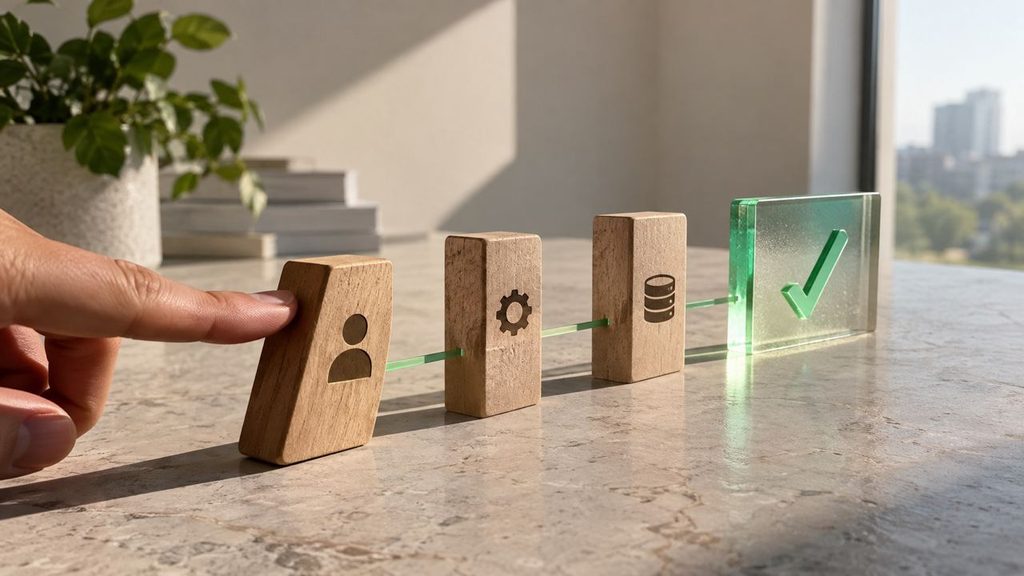
A smart contract is a program stored on a blockchain that executes predefined rules when it receives the right inputs. Instead of asking a company, bank, marketplace, or other intermediary to update a database, users can send transactions to the program and let the blockchain execute its logic.
The name can be misleading. A smart contract does not have to be a legal contract, and it is not “smart” in the artificial-intelligence sense. It is better understood as shared software whose execution is enforced by a blockchain network.
That relatively simple idea is what turns a blockchain from a ledger that records transfers into a platform capable of running exchanges, lending protocols, stablecoins, digital collectibles, games, governance systems, escrow mechanisms, and other decentralized applications.
- What exactly is a smart contract?
- The vending-machine model
- How does a smart contract work?
- 1. Developers define the rules
- 2. The contract is deployed
- 3. A user sends a transaction
- 4. The blockchain executes the contract
- 5. The blockchain records the result
- A simple example: blockchain escrow
- Where does the “automatic” part come from?
- How can a smart contract know what happens outside the blockchain?
- Why do smart contracts matter?
- Deterministic execution
- Shared state
- Composability
- Verifiability
- What are smart contracts used for?
- Are smart contracts really immutable?
- What can go wrong?
- Code can contain bugs
- Public functions can be abused
- Transactions can be irreversible
- External dependencies can fail
- The interface can mislead you
- Smart contract does not mean trust-free
- What should you check before interacting with a smart contract?
- The bottom line
- Sources and further reading
What exactly is a smart contract?
On programmable blockchains such as Ethereum, a smart contract is code deployed to an address on the network. It contains functions that can be executed and may also maintain persistent data known as its state.
Ethereum’s documentation describes smart contracts as programs that run on the Ethereum blockchain. Users and other contracts can interact with them by sending transactions that call functions defined by the contract.
This makes a smart contract different from software running on a conventional company’s server.
| Traditional application | Smart-contract application |
|---|---|
| Backend logic usually runs on company-controlled servers | Contract logic executes through the blockchain network |
| Company controls its database | Blockchain maintains the shared state |
| Operator can often modify records directly | State changes must follow blockchain and contract rules |
| Users trust the operator to execute requests correctly | Network participants independently verify execution |
| Software may be private | On public blockchains, deployed contract activity is generally observable |
The important difference is not that a smart contract somehow understands an agreement. It does not. The difference is that its rules can be executed and verified within a shared system rather than by one organization’s private infrastructure.
The vending-machine model
A vending machine is a useful analogy.
Suppose a machine contains a drink that costs $2. Its logic can be simplified to:
The machine does not negotiate with you. It checks its inputs against predefined rules and produces the corresponding output.
A smart contract works in a similar way. Imagine a blockchain program holding a digital asset. Its rule could be:
If the conditions encoded in the program are satisfied, the contract can perform the specified action. If they are not, the transaction may fail or the requested state change may not occur.
The blockchain provides something the physical vending machine does not: many independent computers can verify that the same rules were applied to the same transaction.
How does a smart contract work?
The exact architecture varies between blockchains, but the basic process can be understood in a few stages.
1. Developers define the rules
A developer writes a program describing what the contract is allowed to do.
Those rules might specify who can withdraw assets, how tokens can be transferred, what happens when two assets are exchanged, or which conditions must be satisfied before an operation succeeds.
Smart contracts can also store information. For example, a token contract may keep track of which blockchain addresses own how many units of a token.
2. The contract is deployed
Before users can interact with a smart contract, its compiled code must be deployed to the blockchain.
On Ethereum, deployment happens through a transaction that creates a contract account containing the contract’s executable bytecode. The deployed contract receives an address that applications and users can reference.
Deployment itself consumes network resources and therefore requires a transaction fee.
3. A user sends a transaction
Suppose you use a decentralized application and press a button labeled “Swap.”
The interface may construct a transaction that calls a particular function in a smart contract. Your wallet shows the request and asks you to authorize it with your cryptographic signature.
The interface is therefore not the smart contract itself. It is simply one way of communicating with it.
4. The blockchain executes the contract
Once the transaction reaches the network and is included for execution, the blockchain’s execution environment processes the requested function.
On Ethereum, this environment is the Ethereum Virtual Machine, or EVM. Ethereum nodes execute EVM instructions and arrive at the resulting network state according to the protocol’s rules.
If the contract says a transfer is permitted only when a particular condition is true, the execution environment checks that condition as part of running the program.
5. The blockchain records the result
If execution succeeds, the resulting state changes become part of the blockchain’s state.
That could mean updating a token balance, transferring an asset, recording a new owner, depositing collateral, or changing a variable stored by the contract.
Other participants can independently verify the resulting state according to the same protocol rules.
A simple example: blockchain escrow
Consider Alice and Bob, who want to exchange a digital asset without allowing either participant to unilaterally control the process.
They could use an escrow smart contract.
A simplified flow might look like this:
- Alice deposits an asset into the contract.
- Bob sends the required payment.
- The contract verifies that its predefined conditions have been satisfied.
- The asset is released to Bob.
- The payment is released according to the contract’s rules.
No employee has to open an internal database and manually approve the exchange. The smart contract coordinates the blockchain-side actions.
Real escrow systems can be considerably more complicated. They may require time limits, dispute mechanisms, multiple signatures, external information, or administrative controls. But the underlying idea remains the same: some of the agreement’s operational rules are represented as executable code.
Where does the “automatic” part come from?
Smart contracts are often described as automatically executing programs. That description needs one important qualification.
A blockchain contract generally does not wake up by itself and inspect the world continuously. Something must trigger its execution, usually through a transaction or another contract call.
For example, a contract could contain a rule saying that funds become withdrawable after a certain time. Reaching that time does not necessarily cause the contract to spontaneously send a transaction. Someone may still need to call the appropriate function.
The automatic part is the enforcement of the programmed result once the relevant function is executed with valid inputs.
How can a smart contract know what happens outside the blockchain?
This reveals one of the most important limitations of smart contracts.
A blockchain can directly verify information that exists inside its own system: addresses, balances, signatures, transactions, contract state, and other onchain data.
It cannot independently know that it rained in London, that a package arrived, that a football match ended 2–1, or that a particular asset has a certain market price elsewhere.
When contracts need external information, they may rely on systems commonly called oracles. An oracle supplies external data in a form a blockchain application can use.
This is sometimes called the oracle problem. Moving trust from execution to data collection does not eliminate trust entirely; it changes where the dependency exists.
Why do smart contracts matter?
Smart contracts expand what a blockchain can represent.
A basic cryptocurrency ledger can answer a question such as “How many coins does this address control?” A programmable blockchain can additionally maintain applications whose state changes according to much more complex rules.
This creates several useful properties.
Deterministic execution
Given the same valid state and inputs, blockchain execution follows predefined protocol and contract rules. Users do not need an employee to decide manually how the program should respond to each transaction.
Shared state
Multiple applications can interact with assets and data maintained by the same blockchain.
A token used in one application, for example, may also be recognized by another smart contract without the two applications maintaining completely separate private databases.
Composability
Smart contracts can interact with other smart contracts.
This allows developers to build applications using existing blockchain programs as components. A new application might interact with a token contract, a decentralized exchange and a lending protocol instead of implementing every function from scratch.
This property is often called composability.
Verifiability
On public blockchains, transactions and contract state can generally be inspected independently. When source code is published and properly matched to deployed bytecode, users and researchers can also analyze what the program is designed to do.
Transparency, however, should not be confused with simplicity. Complex code can be public and still be extremely difficult for ordinary users to understand.
What are smart contracts used for?
Smart contracts are infrastructure rather than a single type of product. They can coordinate many different kinds of blockchain applications.
| Use case | What the smart contract can manage |
|---|---|
| Tokens | Balances, transfers, supply rules and permissions |
| Decentralized exchanges | Rules for exchanging blockchain assets |
| Lending protocols | Deposits, borrowing, collateral and repayment logic |
| NFTs | Ownership and transfer of unique digital tokens |
| DAOs | Voting and execution of certain governance decisions |
| Escrow | Holding and releasing assets under predefined conditions |
| Blockchain games | Ownership and rules involving onchain game assets |
In practice, many applications use a combination of smart contracts and conventional infrastructure. A project’s website, search system, analytics, notifications, customer support, or other services may still depend on centralized servers even when its core asset logic runs onchain.
Are smart contracts really immutable?
You will often hear that smart contracts cannot be changed after deployment. As a basic model, this is useful, but the full picture is more nuanced.
Deployed contract code is generally designed to remain at its blockchain address rather than being edited like a file on a server. However, developers can build systems that are effectively upgradeable.
One common architecture separates persistent state from implementation logic and allows an authorized mechanism to point users toward a new implementation.
Other contracts contain administrator roles capable of pausing certain operations or changing selected parameters.
That means users should ask a more precise question than “Is this on a blockchain?”
What can go wrong?
Replacing human discretion with software does not eliminate risk. It changes the form of risk.
Code can contain bugs
A smart contract executes the rules that were implemented, not necessarily the rules its developers intended.
A programming error can therefore produce unexpected behavior. Because smart contracts can directly control blockchain assets, security vulnerabilities may have immediate financial consequences.
Public functions can be abused
Functions exposed to users must have appropriate access controls. A poorly designed contract might accidentally allow unauthorized accounts to perform sensitive operations.
Ethereum’s security documentation specifically emphasizes access control as a fundamental consideration for contracts that expose functions to the network.
Transactions can be irreversible
Blockchain transactions are not like credit-card payments with a built-in customer-service department capable of reversing every mistake.
If a contract behaves exactly as coded but produces an unwanted result, recovering assets may be difficult or impossible without some separate recovery or administrative mechanism.
External dependencies can fail
A contract may depend on oracles, other contracts, bridges, governance systems, privileged keys, or external infrastructure.
Even if one contract is secure, a failure in a dependency can affect the larger application.
The interface can mislead you
Most users do not interact with raw smart-contract data. They use websites and wallets.
A malicious or compromised interface can attempt to persuade a user to authorize a transaction with consequences they do not understand. A blockchain can verify that a valid private key signed a transaction; it cannot verify that the human understood what the transaction would do.
Smart contract does not mean trust-free
“Trustless” is frequently used to describe blockchain applications, but it can obscure important dependencies.
Smart contracts can reduce the need to trust a particular intermediary to execute certain rules manually. They do not remove every form of trust or risk.
A user may still depend on:
- the contract being correctly written;
- the blockchain operating as expected;
- external data being reliable;
- administrator keys being securely controlled;
- upgrade mechanisms not being abused;
- other connected contracts remaining secure;
- their wallet accurately describing the transaction they are signing.
The useful question is therefore not whether a system requires trust. It is where the trust assumptions are located and whether they can be independently examined.
What should you check before interacting with a smart contract?
You do not need to become a smart-contract developer to develop better habits around blockchain applications.
- Check what you are authorizing. A signature or transaction can grant permissions as well as transfer assets.
- Check the contract address. Similar-looking interfaces and tokens may point to completely different contracts.
- Understand administrative control. Find out whether someone can pause, upgrade or otherwise modify important parts of the system.
- Consider dependencies. Oracles, bridges and external protocols can introduce additional risks.
- Do not treat an audit as a guarantee. Security reviews can reduce risk, but they cannot prove that complex software has no vulnerabilities.
- Be cautious with unfamiliar interfaces. The blockchain may execute exactly what you sign even when the interface that requested the signature is malicious.
The bottom line
A smart contract is best understood as a program running within a blockchain’s execution environment. It receives inputs, applies predefined rules and can update shared blockchain state.
That makes blockchains programmable. Instead of recording only simple asset transfers, they can coordinate exchanges, tokens, lending systems, digital ownership, governance mechanisms and many other applications.
The important innovation is not that the contract can think or understand an agreement. It cannot. The innovation is that multiple participants can rely on a shared network to execute and verify the same program without giving one application operator exclusive control over the underlying state.
That property is powerful, but unforgiving. Smart contracts execute code, not intentions. Understanding that distinction is the foundation for understanding both their usefulness and their risks.
Sources and further reading
For the underlying technical model, see Ethereum’s official documentation on smart contracts, transactions and the Ethereum Virtual Machine:
- Ethereum.org — Introduction to Smart Contracts
- Ethereum.org — Anatomy of Smart Contracts
- Ethereum.org — Ethereum Virtual Machine
- Ethereum.org — Transactions
- Ethereum.org — Smart Contract Security


Discussion